
The Operating Room Was Built for a Body That Is Not Mine. I Built It Better.
On smaller hands, finer instruments, and what structural bias costs when it masquerades as a neutral standard.

Every instrument in a surgical operating room bears the name of the person who designed it.
Debakey. Gorney. Stevens. Bookwalter. Desmarres. The list is long, the pattern unbroken: a century of surgical innovation named for the men who drove it, whose hands shaped the tools of the trade and left their names on every handle as a quiet, permanent record of who built this field. These were brilliant surgeons, genuine pioneers, and I do not invoke them critically. I invoke them as data. Because the instruments they designed were prototyped for their hands — larger, on average, than mine — and those dimensions became the default. Not because they were optimal. Because they were first.
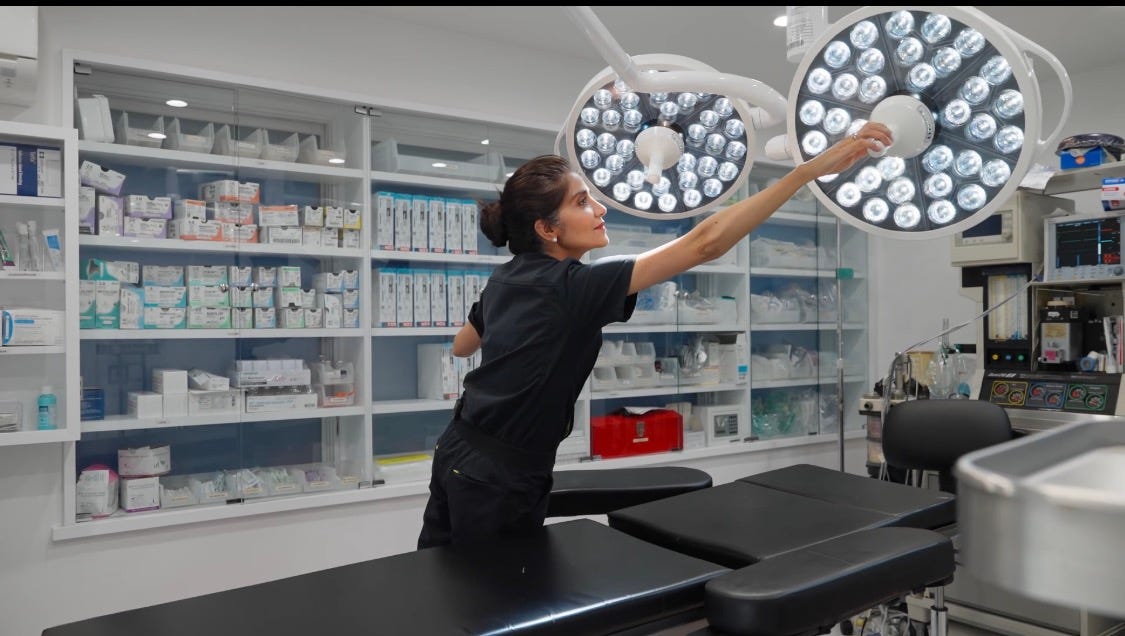
I spent my residency and fellowship standing on a stepstool to reach the operative field, wrestling with instruments calibrated for the average 70-kilogram man, learning to compensate for tools that worked against my natural mechanics rather than extending them. The compensation required is specific and cumulative: using a surgical instrument significantly oversized for your hand is not merely uncomfortable in the way that an ill-fitting glove is uncomfortable. It is mechanically disruptive in the way that using left-handed scissors is disruptive when you are right-handed — the tool works against your natural mechanics at every step, requiring correction, recruiting effort and attention that should be going elsewhere. In surgery, where the margin between a good result and an exceptional one lives in the precision of a single dissection plane, that correction is not neutral. It shows up in fatigue. It shows up in the subtle degradation of fine motor control that accumulates across a long operative day. And over years, it shows up in the body.
I did not speak about this for a long time. Neither did most of my colleagues. In surgical culture, adaptation is a virtue and complaint is a liability, and the women who reached the operating table had little incentive to announce that the conditions were not, in fact, identical for everyone in the room.
Putting Numbers to What Everyone Already Knew
The first thing I did, before I designed anything, was research.
This is the correct order of operations in medicine, and it is the one I applied here. Before a problem can be solved, it has to be measured. Before it can be measured, it has to be named. The ergonomic experience of the female surgeon had been neither named nor measured in any systematic way, which meant that the problem — however widely experienced, however quietly absorbed — had no scientific standing. It existed as anecdote. As the unremarked accommodation of stepping onto a stool and picking up an instrument two sizes too large and getting on with the operation.
I conducted and published a systematic review: “Does One Size Fit All? Gender Equity and the Impact of Surgical Instrument Size on Female Surgeons.” What the literature showed, when compiled and assessed against Cochrane risk of bias standards, was unambiguous.
Studies found that 70 to 85 percent of female surgeons reported discomfort and difficulty with standard instruments. A systematic review of 25 studies involving over 1,500 participants found that 75 percent of female surgeons experienced musculoskeletal discomfort compared to 40 percent of male surgeons. A national survey of 1,000 otolaryngologists found that 85 percent of female surgeons reported ergonomic issues related to instrument design — 80 percent reporting difficulty in instrument handling, 75 percent reporting increased physical strain. Despite women making up 36 percent of the physician workforce, surgical instruments have remained standardized for larger, male hand sizes, contributing to higher rates of musculoskeletal disorders and, in documented cases, decreased surgical performance.
These numbers matter not because they surprised any female surgeon who read them, but because they were now in the literature. Peer-reviewed, citable, structurally established. The experience that had been absorbed quietly for decades by an entire cohort of surgeons had been converted into data — and data, in medicine, is what precedes change.
The review also documented something the ergonomic framing tends to obscure: musculoskeletal disorders are among the leading causes of early career exit in surgery. A surgeon who develops chronic hand, wrist, or shoulder injury from years of working with instruments sized incorrectly for her anatomy does not simply suffer personally — she leaves the field. Her training, her accumulated expertise, her patients: all of it exits with her. The instrument size problem is not a comfort issue. It is a retention issue. A pipeline issue. A patient care issue. The stepstool is the visible part. The invisible part is the surgeon who is no longer there.
The Argument That Has Almost Never Been Made
Here is the part of the conversation that is almost never reached, because the discussion of ergonomic equity tends to frame smaller hands as a disadvantage to be accommodated rather than what they actually are: a distinct clinical asset.
Smaller hands access anatomical spaces that larger hands cannot enter. They navigate tissue with a tactile sensitivity that is a direct function of finger size relative to the structures being handled — a spatial relationship that translates into finer discrimination at the operative level. In microsurgery, in facial plastic surgery, in the delicate dissection planes of a deep facelift or a rhinoplasty, the hand that occupies less space in the field is, in many contexts, the better instrument. It disturbs less. It perceives more. The meticulous, miniscule result — the result that plastic surgery at its highest level demands — is not achieved despite smaller hands. In many cases, it is achieved because of them.
This has not historically been recognized as a structural advantage because the field’s design assumptions never required that recognition. If the default hand is large, the default instrument is large, and the entire ergonomic ecosystem is calibrated to that scale, then the smaller hand is defined by what it lacks relative to the standard rather than by what it offers on its own terms. The standard, in other words, determines what counts as an advantage.
Fine watchmakers do not use instruments designed for larger hands. Neurosurgeons operating at the millimeter scale select instruments accordingly. The logic that in precision surgery, finer tools in more precise hands produce more refined results is not controversial in any other context. It became invisible in surgery because the field was built by people for whom it did not apply.
The instruments I designed are not an accommodation for a deficit. They are an optimization for a capability that the field had simply failed to equip.
A Harvard Capstone That Became Something Else
I developed the instruments as my capstone project for the Harvard Surgical Leadership Program — a structured exercise in applying leadership principles to a problem within one’s own domain. The assignment was to identify a systemic issue, develop a solution, and present it. I had identified the problem years earlier and spent most of my training living inside it. What the program provided was the framework to move from structural observation to designed intervention.
What I did not anticipate was that the project would not end with the presentation.
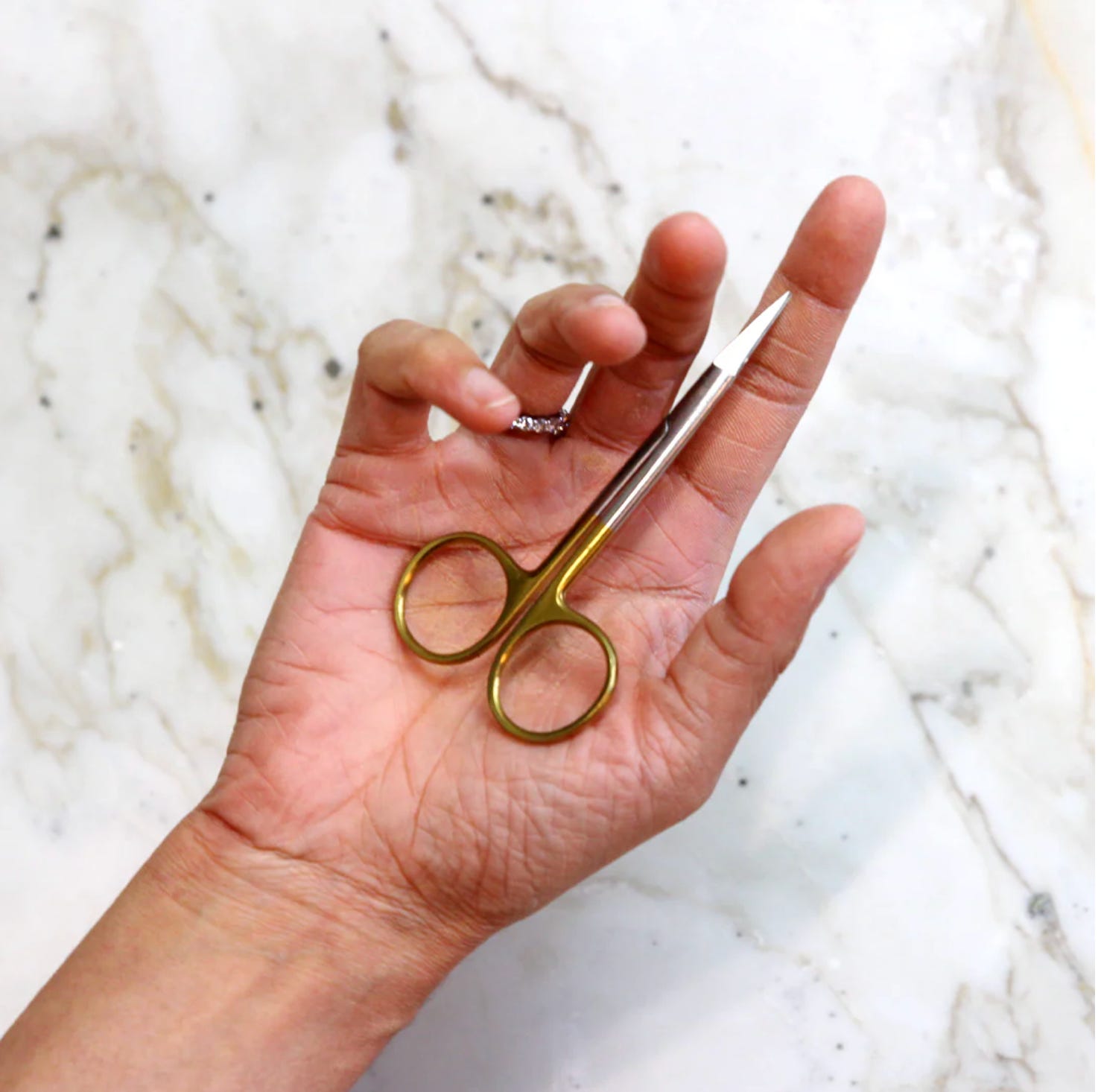
The dissection scissors and precision calipers I designed are radical in the way that the most consequential instruments always are: not because they introduce a new technology, but because they redefine who the technology is for. The scissors are a modification of the standard iris scissor — curved, crafted from high-grade stainless steel — but engineered from first principles for a smaller operative hand. The supercut blades are beveled and ultra-sharp, capable of dissecting and trimming soft tissue and skin at millimeter-level precision without the crush artifact that duller instruments produce. The tips are refined to a fineness that standard-sized scissors, designed for a larger grip, do not require and therefore do not achieve. The sizing parameters are specific: blade length 2.5 centimeters, scissor ring diameter 2.5 centimeters, ring width in palm 5 centimeters, total instrument length 10 centimeters. These are not approximations. They are the product of designing backwards from the hand rather than forwards from a historical template. The instruments are suited to the full range of precision facial and body procedures — facelifts, blepharoplasty, rhinoplasty, breast surgery, abdominoplasty — anywhere that the quality of a result is determined at the level of individual tissue planes.
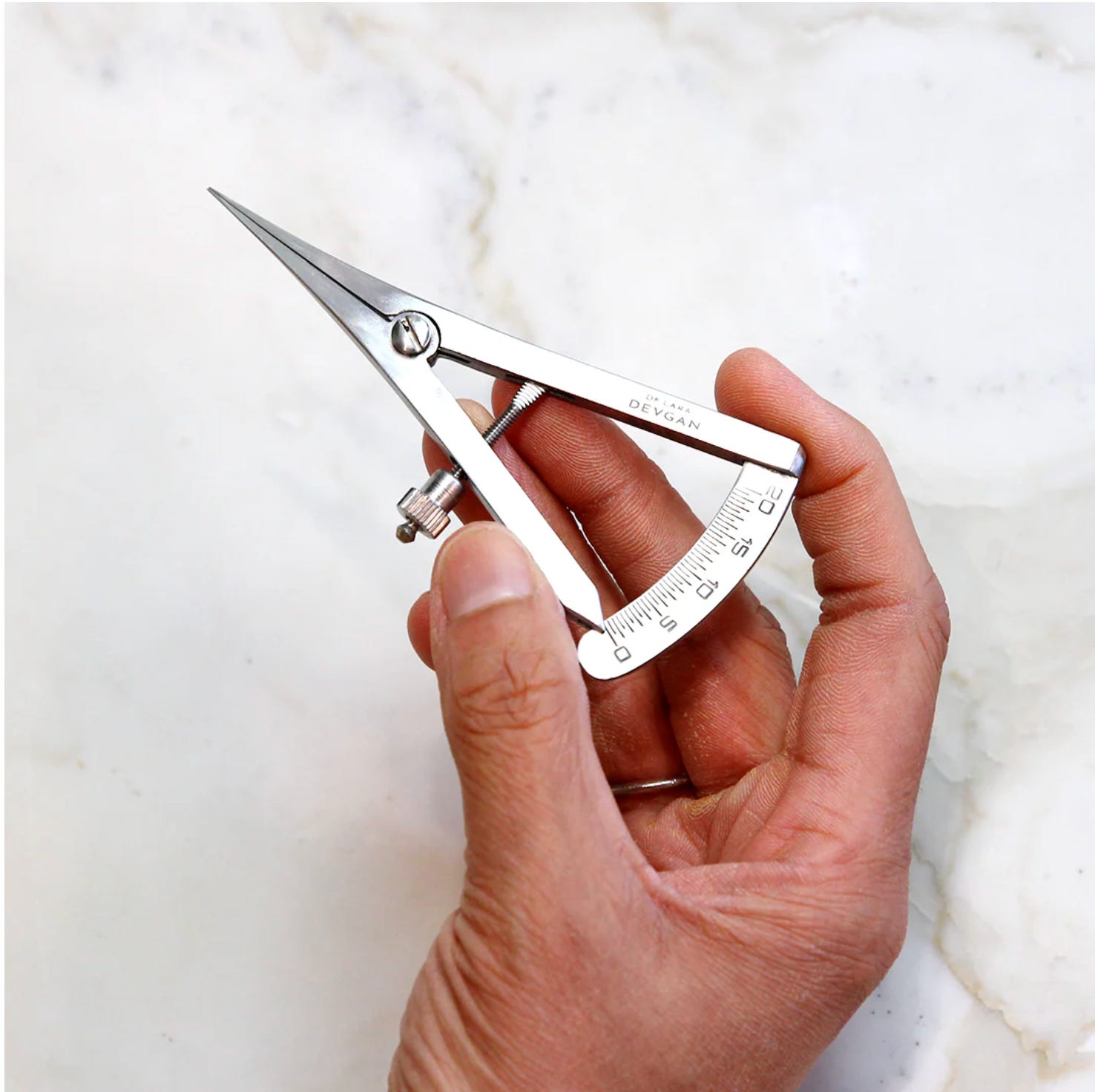
The precision calipers are a modification of Castroviejo measuring calipers, self-retaining, graduated from 0 to 20 millimeters in calibrated 1-millimeter increments — the scale at which plastic surgery operates and at which errors, when they occur, produce visible consequences. The fine tips and compact grip translate directly into the kind of meticulous measurement that differentiates a symmetrical result from one that is merely close. My philosophy has always been that beauty is in the details — and the details, in surgery, are measured in millimeters by instruments that must fit the hand doing the measuring.
What these instruments represent is not a modest ergonomic adjustment. They enfranchise an entire segment of the surgical workforce that has been compensating, adapting, and working around a deficit that was never named as such. They are surgical tools designed by a woman surgeon, for surgeons whose hands had never been the design parameter — and they perform, at the operative level, better than the instruments they replace.
They bear my name. That detail is not incidental. Every instrument in the operating room bears the name of the person who designed it. Adding a woman’s name to that list is not vanity. It is historical correction. When a surgeon calls for Devgan scissors across an operating table, she is adding one more data point to the record of whose hands have been here — and whose name belongs on the wall of the room.
When Architecture and Design Noticed


I did not design the instruments for architects. I designed them for surgeons.
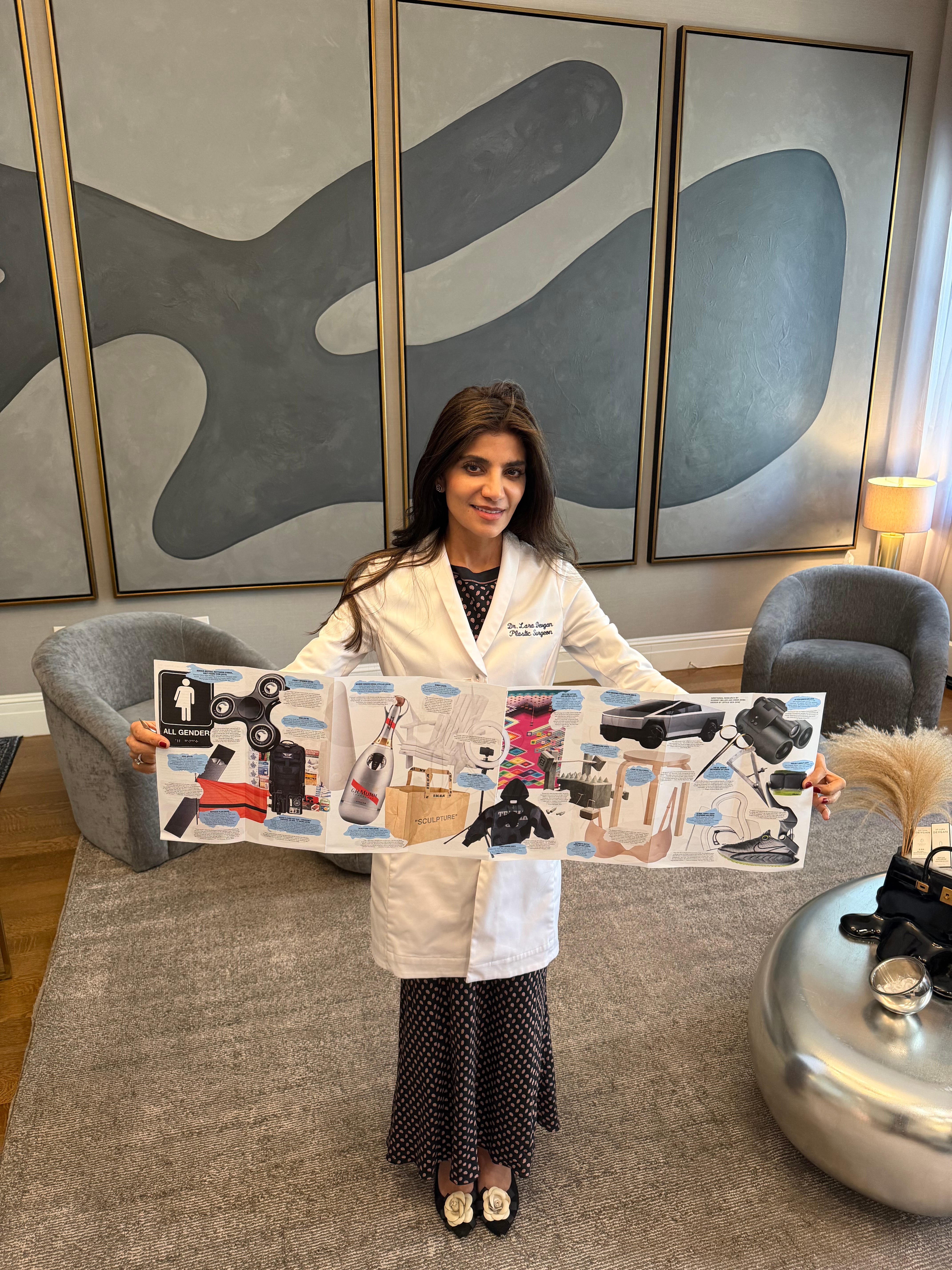
Which is why it was genuinely unexpected when PIN-UP Magazine — marking 20 years of publication with a special collector’s edition surveying the 40 objects that define the early 21st century, curated by Alexandra Cunningham Cameron of the Cooper Hewitt, Smithsonian Design Museum — included the instruments in that canon.
PIN-UP is not a medical publication. It is a biannual independent architecture and design magazine, subtitled The Magazine for Architectural Entertainment, that operates at the intersection of architecture, design, fashion, art, and culture. Its 40th issue is a collector’s edition assembled across ten individual publications, asking a single organizing question: which objects will come to represent the first quarter of this century when someone looks back at it from a distance? The answer, as Cunningham Cameron assembles it, is a list that resists any single curatorial logic — and that is precisely what makes it interesting.
The 40 objects include Konstantin Grcic’s Noctambule lighting system for Flos, transparent glass cylinders that glow from within with near-invisible technology; Jasper Morrison’s Superloon floor lamp, which translated edge-lit display technology from the smartphone screen to a luminous disk of monumental scale; Philippe Starck’s crystal lamp for Baccarat with Jenny Holzer’s Truisms — “PROTECT ME FROM WHAT I WANT,” “MONEY CREATES TASTE” — scrolling through its structure in a collision of political language and opulent material. Also in the list: the Juul, the object that industrialized nicotine addiction and repackaged it as a design product sleek enough to disappear into a palm; the Croc, the foam clog that began as a boating shoe, became a punchline, and then became ubiquitous in a way that collapsed every category of taste it touched; the Tesla Cybertruck, an object so aggressive in its rejection of automotive convention that it reads less as a vehicle than as a provocation; the selfie ring light, the democratizing device that gave anyone with a phone the lighting infrastructure previously available only to professional photographers — and that changed, in the process, how an entire generation understands its own image; the unisex bathroom sign, a rectangle of institutional design whose emergence as a contested object encodes more about the politics of this era than most artworks produced in it; and the Virgil Abloh x IKEA tote bag, labeled “SCULPTURE” that asked, with more precision than most critical theory, where the boundary between design and art actually sits.
These are not objects chosen for aesthetic merit alone. They are chosen because they are symptomatic — because each one, in its own register, reveals something about how power, access, identity, technology, and culture have been reorganized in the first quarter of this century.
That a pair of surgical scissors appears in this company is not incidental. A surgical scissor sized for a woman’s hand is not only a clinical tool. It is an object that encodes a precise set of assumptions about who a professional is, what body she inhabits, and whether the built environment of her work was constructed with her in mind. Like the unisex bathroom sign, it makes an argument about whose body has historically been accommodated and whose has been treated as an afterthought. Like the IKEA tote labeled “SCULPTURE,” it asks what happens when an object designed for function is recognized as something that carries meaning beyond it. Like the ring light, it is a tool whose implications extend well past its immediate utility — redistributing access to something that was previously unavailable to an entire category of person.
Placed alongside the other objects of the early 21st century, the instruments make an argument that has nothing to do with medicine and everything to do with design as a political act: that the things we build, and the bodies we build them for, are never neutral choices.
What the Operating Room Reveals That Nothing Else Does
I want to be precise about what instrument mismatch means at the operative level, because abstraction does not fully convey it.
When an instrument is too large for the surgeon’s hand, the grip required to control it is compensatory rather than natural. The hand recruits muscles that would otherwise be relaxed, sustaining tension that dissipates quickly in a correctly fitted hand but accumulates across the length of a case in one that is not. The result is a surgeon who is working harder than necessary to produce the same result — expending physiological resources on compensation that should be available for the work itself. In plastic surgery, where operations are measured in millimeters and the quality of a result is determined by decisions made at the level of individual tissue planes, that resource expenditure matters. Fatigue degrades precision. An instrument that fights the hand holding it does not produce the same result as one that extends it.
The inverse is equally true and considerably less discussed. Smaller hands, correctly equipped, do not merely perform comparably to larger hands. In many of the most demanding contexts in surgery, they perform better. The access they provide to confined anatomical spaces, the tactile discrimination they afford at the scale of delicate dissection, the economy of movement they bring to procedures requiring the finest possible motor control — these are capabilities, not compensations. They have simply never been recognized as such because the field never needed to recognize them. The default was different. The default defined what mattered.
What This Is Really About
There is a version of this story that is about scissors.
The complete version is about what it means to work for a career in a domain whose infrastructure was built for someone else — and what it produces in the person who does. Not bitterness, in most cases. Something more efficient than that: a finely developed capacity for functioning inside structural disadvantages that were never acknowledged as such, because they were never visible to the people for whom they did not exist.
Female surgeons are exceptionally good at adaptation. The stepstool. The compensatory grip. The modified technique accumulated over years of training on equipment calibrated for a different anatomy. These adaptations are invisible in outcomes and invisible in credentials. They show up, eventually, in the body — in musculoskeletal injury rates measurably higher in female surgeons than male, in the career truncations that follow, in the attrition of exactly the people the pipeline worked so hard to produce.
A well-designed instrument does not solve all of this. It does not rename the operating room or rewrite the history of whose hands built the field. What it does is smaller and more precise: it removes one friction, one daily compensation, one structural assumption that defined smaller hands as a problem to be worked around rather than an asset to be equipped. It puts a tool in a surgeon’s hand that was made for that hand. That extends it rather than fights it. That carries her name on the handle, alongside all the others, as a permanent record that she was here — and that she built something better.
The instruments began as a capstone. They became a product. They were recognized as a cultural object. What they remain, at their core, is a clinical argument: that the operating room is more precise, more capable, and more just when it is designed for the full range of people performing surgery in it.
That argument is still being made. These instruments are one way of making it.
Read the full systematic review: “Does One Size Fit All? Gender Equity and the Impact of Surgical Instrument Size on Female Surgeons: A Systematic Review” on ResearchGate.
The Dr. Devgan Surgical Instruments — dissection scissors and precision calipers — are available at drlaradevgan.com.